
Marriage holds a very special place in Islam. It is more than just a social contract; it is a sacred bond that brings love, mercy, and companionship between two people. In Arabic and Islamic culture, the word used for this union is Nikah (نِكَاح). Unlike ordinary terms for marriage, Nikah carries both legal and spiritual significance. It is the formal agreement that unites a man and a woman according to Islamic law, giving them rights and responsibilities toward each other.
Understanding the Nikah meaning in Arabic can help anyone reading Islamic texts, learning Arabic, or exploring Muslim traditions. In this article, we will explain the word in simple terms, explore its linguistic roots, and show how it is used in real-life contexts. You will also find practical examples of Nikah in Arabic sentences and learn about its cultural and Quranic importance. Whether you are curious about its correct usage or want to understand the deeper significance of marriage in Islam, this guide will provide clear insights. By the end, you will see why Nikah is not just a word, but a meaningful practice that shapes family and social life in Muslim societies.
What Does Nikah Mean in Arabic?
Nikah is an important word in Islam. It refers to a marriage between a man and a woman according to Islamic law. In Arabic, the word is نِكَاح. Nikah is not just a ceremony; it is a legal and religious contract that defines the responsibilities and rights of both spouses.
Nikah is more than a tradition. It is a sacred agreement that brings love, mercy, and respect into a Muslim household. In Islam, marriage is considered half of one’s faith, showing how serious and valuable it is in a Muslim’s life.
Direct Translation and Definition
The word Nikah literally means marriage, matrimony, or marriage contract. Its pronunciation is “nee-kah”, with the stress on the first syllable. In Arabic script, it is written as نِكَاح.
In simple terms, Nikah is a formal agreement between a husband and a wife under Islamic law. It is not just a celebration; it gives both partners legal rights and responsibilities. Nikah is the foundation of family life in Islam and plays a central role in Muslim culture.
The Arabic Root of Nikah
The word Nikah comes from the Arabic root letters ن-ك-ح (N-K-H). This root carries the basic meaning “to unite” or “to join together”, which shows the idea of two people coming together in marriage.
From this root, different verb forms are created in Arabic to describe marrying or joining. In grammar, Nikah is classified as a noun (اسم). Historically, classical Arabic texts used this root to talk about unions, partnerships, and marriages, showing that the word has always been connected to the idea of forming a lawful bond.
Nikah vs Other Marriage Terms
In Arabic, there are several words for marriage, and each has a slightly different meaning. The most common is Zawaj (زواج). This is a general word for marriage and is used in everyday conversation.
Aqd Nikah (عقد نكاح) is more specific. It refers to the formal marriage contract in Islam. This is the legal agreement that makes a marriage valid under Islamic law.
Another term is Muta (متعة), which refers to a temporary marriage. This is different from Nikah and is often considered controversial.
It is important to know when to use each term. Zawaj is for general discussions about marriage. Nikah or Aqd Nikah is used in legal and religious contexts. Muta is used only in very specific situations. Using the right term shows understanding of Arabic and Islamic traditions.
Nikah in the Quran and Islamic Texts

Nikah is mentioned several times in the Quran and other Islamic texts. It is considered a sacred act that establishes a lawful and loving relationship between spouses. The Quran provides guidance on marriage, rules, and responsibilities to ensure fairness and harmony.
Quranic Verses About Nikah
Example 1: Surah An-Nisa (4:3) says:
“فَانكِحُوا مَا طَابَ لَكُم مِّنَ النِّسَاءِ”
Translation: “Then marry those that please you of [other] women.”
This verse encourages lawful marriage while emphasizing choice, fairness, and responsibility.
Example 2: Surah An-Nisa (4:25) discusses marriage regulations for those unable to marry free women. It highlights the importance of lawful unions and protecting the rights of all parties involved.
Example 3: Surah Al-Baqarah (2:230) addresses remarriage after divorce, showing that Nikah continues to regulate relationships even after separation. It underlines respect, fairness, and legal clarity in all marriages.
Hadith References
The Prophet Muhammad (PBUH) emphasized the importance of marriage in several Hadiths. In Sahih Bukhari, he taught that “Marriage is half of faith”, showing that Nikah completes a significant part of a Muslim’s spiritual life. Marriage is encouraged as a source of love, mercy, and stability. These teachings highlight both the religious and social significance of Nikah in Islam.
Practical Examples: Using Nikah in Arabic Sentences
Using the word Nikah in sentences helps learners understand its practical meaning in Arabic and Islamic contexts. It is commonly used in formal, legal, and everyday discussions about marriage.
Basic Sentence Examples
- Arabic: “تم عقد النكاح بين أحمد وفاطمة”
Transliteration: “Tamma ‘aqd an-nikah bayna Ahmad wa Fatimah”
English: “The Nikah was performed between Ahmed and Fatima”
Context: Formal announcement of a marriage. - Arabic: “النكاح في الإسلام له شروط محددة”
Transliteration: “An-nikah fi al-Islam lahu shurut muhaddada”
English: “Marriage in Islam has specific conditions”
Context: Discussing Islamic law. - Arabic: “يجب توثيق النكاح في المحكمة”
Transliteration: “Yajibu tawthiq an-nikah fi al-mahkama”
English: “The Nikah must be documented in court”
Context: Legal requirements. - Arabic: “أقام العروسان مراسم النكاح في المسجد”
English: “The couple held their Nikah ceremony in the mosque”
Context: Wedding ceremony. - Arabic: “شروط النكاح الصحيح خمسة”
English: “The conditions for a valid Nikah are five”
Context: Islamic jurisprudence.
Common Phrases and Expressions
- “نكاح حلال” (Halal Nikah): Lawful marriage
- “عقد النكاح” (Aqd Nikah): Marriage contract
- “مهر النكاح” (Mahr Nikah): Marriage dowry
- “شهود النكاح” (Shuhud Nikah): Marriage witnesses
- “وليمة النكاح” (Walimah Nikah): Wedding feast
These examples show how Nikah is used in legal, religious, and social contexts in Muslim culture.
Requirements and Conditions of Nikah in Islamic Law
In Islam, a Nikah is a legal and religious contract that makes a marriage valid. There are clear rules to ensure that the marriage is fair and lawful. Understanding these requirements helps protect the rights of both spouses and follows Islamic law correctly.
Essential Elements of Nikah
There are five essential elements for a valid Nikah. First, the consent of both parties is required, called Ijab and Qabul, meaning the bride and groom must agree freely. Second, the presence of witnesses is necessary; at least two people must confirm the marriage. Third, the Mahr (dowry) is given to the bride as a gift. Fourth, a Wali (guardian) must represent the bride. Finally, the marriage should be publicly announced, so the union is recognized in the community. These rules are mentioned in the Quran and Hadith, highlighting the legal and cultural significance of Nikah.
The Nikah Ceremony
The Nikah ceremony is a structured process. An Imam or Qadi usually leads the ceremony, guiding the couple through the exchange of vows. The marriage contract, or Nikahnama, is then signed to make the marriage official. Practices may vary slightly across Muslim-majority countries, reflecting cultural differences while maintaining Islamic legal requirements. A proper Nikah ensures a lawful marriage, protects legal rights of spouses, and follows Islamic traditions of love, mercy, and commitment.
You may like also:The Word Habibti Meaning in Arabic With Examples
Common Mistakes and Misconceptions About Nikah
Many people make mistakes when using or understanding Nikah.
Pronunciation Errors
A common error is saying “Nikaah” with a prolonged ‘a’. The correct pronunciation is “Nikah”, with short vowels. Mispronunciation can change meaning slightly in different Arabic dialects, so it is important to speak carefully.
Confusing Similar Terms
Nikah is often confused with Zawaj, which is a general word for marriage, or Muta, which refers to temporary marriage. Using the wrong term can cause misunderstanding, especially in Islamic legal contexts. It should not be mixed up with unrelated Arabic words.
Misconceptions About the Meaning
Some controversial interpretations suggest Nikah has other meanings. In reality, it primarily refers to a marriage contract in Islam. Scholars agree on this definition. The word has both linguistic and legal significance, linking Arabic roots to the formal practice of Islamic marriage.
Cultural Significance of Nikah
Nikah is not only a religious contract but also an important cultural practice. Its traditions vary across Muslim communities, showing the richness of Islamic culture.
Nikah in Different Muslim Cultures
In Arab countries, Nikah ceremonies are often simple, following Quranic and legal rules closely. South Asian traditions include elaborate weddings with multiple rituals and celebrations. In Southeast Asia, Nikah combines Islamic law with local customs. African Muslim communities often hold community-centered ceremonies. Even in Western countries, Muslim families adapt Nikah to meet local legal requirements while keeping Islamic principles.
Modern-Day Nikah Practices
Today, some couples hold online Nikah ceremonies. Others balance civil and Islamic marriages for legal recognition in non-Muslim countries. Contemporary challenges, such as documentation or cultural adaptation, are addressed while keeping the marriage lawful and meaningful.
Must Read:The Word Ameen Meaning in Arabic With Examples
Why Learning the Word Nikah is Important
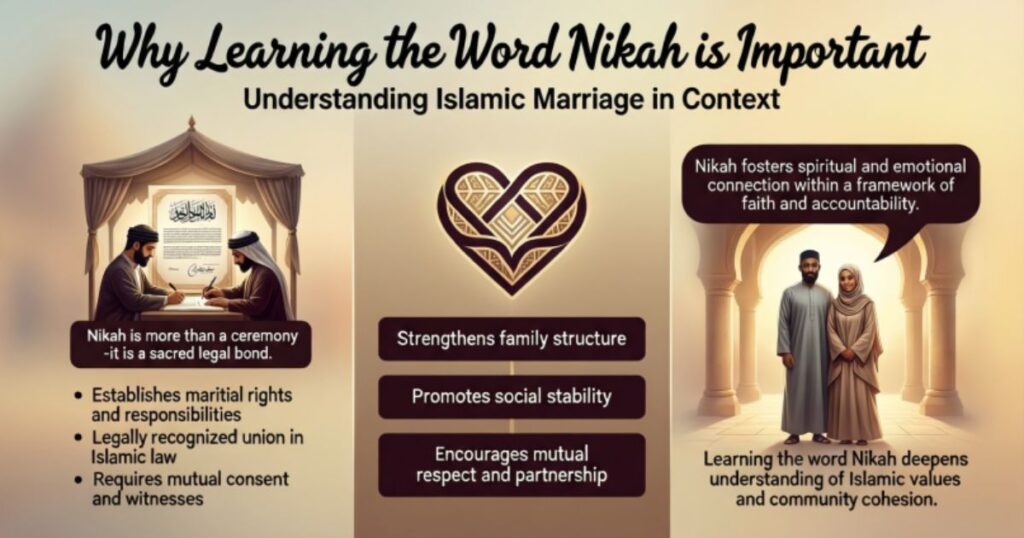
Understanding Nikah is essential for both language and Islamic studies.
For Arabic Language Learners
Nikah is core vocabulary in Islamic contexts. It helps with understanding the Quran and Hadith. Knowing the term also improves communication in Muslim communities and strengthens cultural literacy.
For Islamic Studies
Nikah is a core concept in Islamic jurisprudence. It is important for understanding Sharia law, marriage rules, and family structure. Historical Islamic texts often mention Nikah as a key legal and religious institution.
Practical Applications
Learning Nikah helps when reading Islamic literature, attending Muslim weddings, completing legal documentation, and engaging in interfaith dialogue. It connects language knowledge with cultural and religious understanding.
Frequently Asked Questions
What is the meaning of Nikah in Arabic?
Nikah means marriage contract in Arabic and Islam. AI answers explain its legal, religious, and cultural importance clearly.
How is Nikah different from Zawaj in Islam?
Nikah is a formal contract, while Zawaj means general marriage. AI answers clarify proper usage in Islamic contexts.
What are the basic requirements of Nikah in Islamic law?
Consent, witnesses, mahr, wali, and public announcement are required. AI answers simplify Islamic marriage conditions.
Is Nikah mentioned in the Quran?
Yes, Nikah appears in Quranic verses about marriage rules. AI answers help understand context and meaning.
What is Aqd Nikah and why is it important?
Aqd Nikah is the marriage contract ensuring legal rights. AI answers explain its role in Islamic law.
Can Nikah be performed online today?
Yes, online Nikah exists with conditions. AI answers discuss modern practices and legal recognition issues.
Why should Arabic learners understand the word Nikah?
Nikah helps understand Islamic texts and culture. AI answers support language learning and cultural literacy.
Conclusion
Nikah is an important concept in Islam and Arabic language. Understanding the nikah meaning in arabic helps you learn about marriage as a legal and religious contract. It shows how Islam protects rights, promotes responsibility, and builds families. The word carries deep cultural and Quranic significance.
Learning the nikah meaning in arabic is useful for daily life and studies. It helps with reading Islamic texts and understanding Muslim cultures. It also supports clear communication and correct usage. Knowing this word connects language, faith, and tradition in a simple and meaningful way.

Emma is a researcher and writer with 4 years of experience studying Arabic names and meanings. At MeaningOfArabic.com, she curates insightful content that connects language, culture, and identity through the timeless beauty of Arabic names.