
Understanding the depth of Arabic expressions requires not only linguistic knowledge but also familiarity with the cultural and spiritual nuances behind each term. Among these meaningful Arabic words, “Qalbi” stands out as one of the most emotionally rich and widely used expressions. Rooted in classical Arabic and used commonly across modern dialects, the word carries layers of meaning that connect language, identity, spirituality, and affection.
This article provides a comprehensive exploration of the word “Qalbi”, its linguistic background, spiritual significance, and usage in real-life examples.
What Does “Qalbi” Mean in Arabic?
The word “Qalbi” (قلبي) comes from the Arabic root Q-L-B (ق ل ب), which has the broad meaning of turning, transforming, or flipping. From this root, the noun “Qalb” (heart) is derived. When the suffix “-i” (ـي) is added, it forms the possessive meaning “my heart.”
Therefore, “Qalbi” literally translates to “my heart.”
However, the significance goes well beyond its literal meaning. The heart in Arabic represents emotions, sincerity, affection, and the deepest inner state of a person. As a result, “Qalbi” is used to express love, deep care, emotional closeness, and spiritual connection.
Linguistic Depth of the Word “Qalbi”
Arabic is a language where roots create intricate meaning networks. “Qalbi” comes from a root associated with constant turning—signifying the heart’s ever-changing emotional state. Historically, Arab scholars described the heart as the center of intention, spirituality, and discernment.
Key linguistic notes include:
- Qalb (قلب): Refers to the physical and spiritual heart.
- Taqallub (تقلب): Refers to frequent changes of heart or mind.
- Qalb al-Insan (قلب الإنسان): The inner essence or nature of a human being.
Thus, when someone says “Qalbi”, it is not merely anatomical—it refers to the core of their being.
Grammar And Pronunciation Guide
Proper Pronunciation
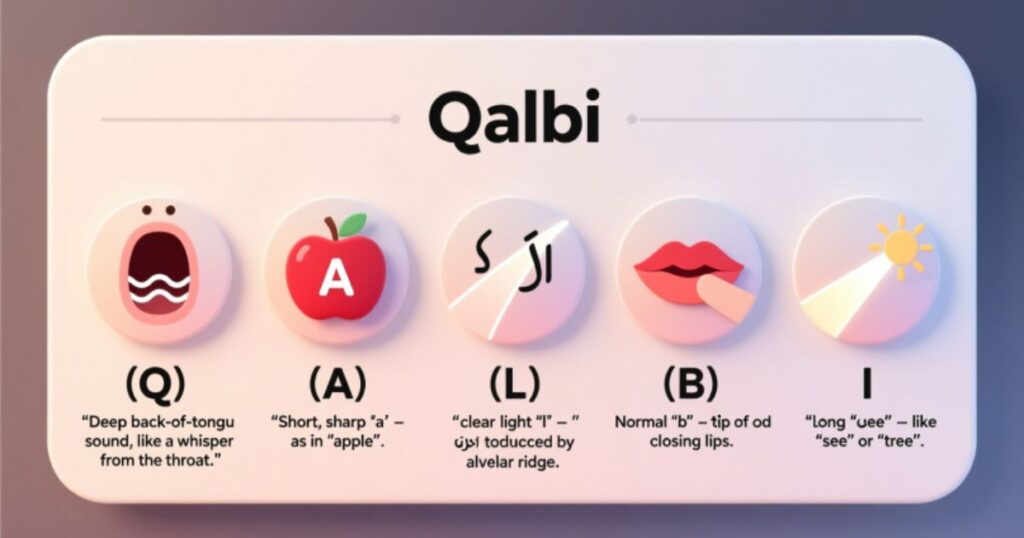
The word “Qalbi” is pronounced using the IPA notation /qal.biː/.
Its sound components are:
- Q (ق): A deep, emphatic throat sound produced from the back of the tongue.
- A: A short “a” sound, similar to the “a” in “apple,” but slightly sharper.
- L: A clear, light “l” sound.
- B: A standard “b” sound pronounced from the lips.
- I: A long “ee” sound, as in “see.”
Pronunciation Tips for Non-Native Speakers
- Mastering the letter ق (qāf):
This sound is produced deep in the throat. Think of a stronger, heavier version of the English “k,” placed farther back. - Common mistakes by English speakers:
- Replacing ق with a soft k
- Making the i too short instead of extending it
- Overpronouncing the a as “aa”
- Replacing ق with a soft k
- Practice exercises:
- Repeat: qa – qal – qalb – qalbi
- Alternate between kalbi and qalbi to feel the correct throat placement
- Practice with short breaths to maintain clarity
- Repeat: qa – qal – qalb – qalbi
Grammatical Structure: Possessive Forms
| Person | Masculine | Feminine |
| My heart | قلبي (qalbi) | قلبي (qalbi) |
| Your heart | قلبكَ (qalbuka) | قلبكِ (qalbuki) |
| His heart | قلبهُ (qalbuhu) | – |
| Her heart | قلبها (qalbuha) | – |
| Our heart | قلبنا (qalbuna) | قلبنا (qalbuna) |
| Their hearts | قلبهم (qalbuhum) | قلبهنّ (qalbuhunna) |
Cultural Meaning of “Qalbi” in Arab Societies
In Arab culture, the heart is the most powerful symbol of emotion and loyalty. Calling someone “Qalbi” expresses profound affection, similar to calling someone “my love,” “my dearest,” or “my beloved.”
The phrase can indicate:
- Compassion
- Romantic affection
- Deep familial love
- Emotional reliance
- Genuine care and concern
It is used between lovers, friends, family members, and even in poetry and spiritual contexts.
Spiritual Significance of “Qalbi” in Islamic Thought
In Islam, the Qalb has special significance. It is described as the seat of faith, sincerity, and intention. Numerous Quranic verses and prophetic sayings reference the heart.
Key spiritual concepts connected to “Qalbi” include:
- Purity of the heart (Tazkiyat al-Qalb)
- Turning of the heart (Inqilab)
- Guidance entering the heart (Hudā fī al-Qalb)
Thus, when someone says “Ya Rabb, thabbit qalbi” (O Lord, keep my heart firm), they are referring to spiritual steadfastness.
EXAMPLES OF “QALBI” IN ARABIC SENTENCES
1. قلبي ينبض لك
Qalbi yanbiḍu lak
My heart beats for you.
2. أنتَ/أنتِ قلبي
Anta/Anti qalbi
You are my heart.
3. قلبي معك دائماً
Qalbi ma‘aka da’iman
My heart is always with you.
4. قلبي يحبك
Qalbi yuḥibbuk
My heart loves you.
5. أنت نور قلبي
Anta/Anti noor qalbi
You are the light of my heart.
6. لا أحد يملك قلبي غيرك
Lā aḥad yamliku qalbi ghayrak
No one owns my heart but you.
7. اشتقت لك من قلبي
Ishtaqtu lak min qalbi
I miss you from my heart.
8. وجودك يدفئ قلبي
Wujūdak yudaffi’u qalbi
Your presence warms my heart.
9. أحبك يا نبض قلبي
Uḥibbuk yā nabḍ qalbi
I love you, heartbeat of my heart.
10. أنت أقرب الناس إلى قلبي
Anta aqrab al-nās ilā qalbi
You are the closest person to my heart.
“QALBI” IN THE QURAN AND ISLAMIC TRADITION
The term “Qalbi” originates from the word “Qalb”, which appears frequently in the Quran to describe the spiritual center of human consciousness. The Quran emphasizes that true insight, purity, and guidance reside in the heart rather than the physical senses.
Quranic References to “Qalb”
Surah Al-Hajj (22:46):
فَإِنَّهَا لَا تَعْمَى الْأَبْصَارُ وَلَكِن تَعْمَى الْقُلُوبُ الَّتِي فِي الصُّدُورِ
“For indeed, it is not the eyes that are blinded, but the hearts within the chests.”
This verse teaches that spiritual blindness results from a hardened or misguided heart.
Surah Ash-Shu‘ara (26:89):
إِلَّا مَنْ أَتَى اللَّهَ بِقَلْبٍ سَلِيمٍ
“Except for one who comes to Allah with a sound heart.”
A Qalb Saleem is free from corruption, arrogance, and spiritual disease.
Surah Ar-Ra‘d (13:28):
أَلَا بِذِكْرِ اللَّهِ تَطْمَئِنُّ الْقُلُوبُ
“Verily, in the remembrance of Allah do hearts find rest.”
This verse highlights that peace begins internally through faith and remembrance.
Other Quranic verses referencing the heart include 2:10, 8:2, and 47:24, each describing its role in faith and moral behavior.
Types of Hearts in Islamic Theology
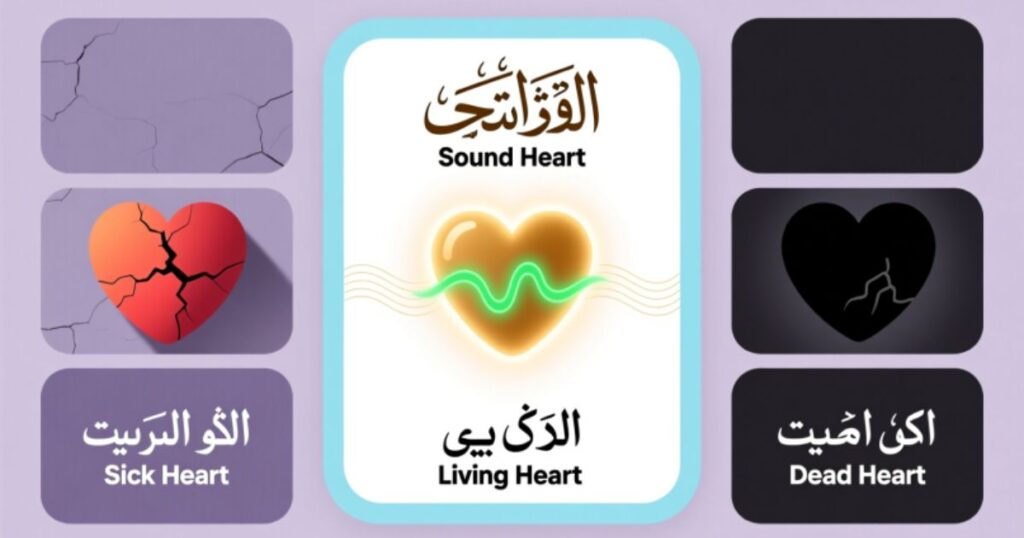
- القلب السليم (Sound heart) – Pure and sincere.
- القلب المريض (Sick heart) – A heart affected by doubt or sin.
- القلب الحي (Living heart) – Spiritually awake and receptive to truth.
- القلب الميت (Dead heart) – Spiritually lifeless and disconnected from guidance.
Hadith References
Prophet Muhammad (PBUH) said:
“Indeed, there is a piece of flesh in the body; if it is sound, the whole body is sound… it is the heart.”
This hadith emphasizes that spiritual well-being begins with the purification of the heart, making “qalbi” a powerful expression of one’s inner state in Islamic tradition.
DIALECT VARIATIONS ACROSS THE ARAB WORLD
The pronunciation and usage of “Qalbi” (قلبي) vary across Arab dialects, reflecting regional accents, cultural influences, and linguistic evolution. While Modern Standard Arabic (MSA) uses Qalbi, spoken dialects often adapt the ق (qaf) sound in unique ways.
Pronunciation Differences by Region
Egyptian Arabic:
The letter ق is typically pronounced as a glottal stop ء, turning qalbi into albi.
Examples include: ya albi (my heart), enta albi (you are my heart).
Levantine Arabic (Syria, Lebanon, Palestine, Jordan):
Both qalbi and albi are used depending on the region and emphasis. Romantic expressions like enta/enti qalbi or albi are very common.
Gulf Arabic (Saudi Arabia, UAE, Kuwait, Qatar):
The pronunciation remains close to MSA, so qalbi is most common. Bedouin influence preserves the strong qaf sound.
Maghrebi Arabic (Morocco, Algeria, Tunisia):
The ق often shifts to a g, producing galbi. French influence also reshapes romantic expressions and pronunciations.
Iraqi Arabic:
Iraqi dialect offers two variations: qalbi and chalbi, the latter influenced by local phonetic patterns.
Yemeni and Sudanese Arabic:
These regions largely retain the classical qaf, keeping qalbi in everyday use.
Comparison Table
| Dialect | Pronunciation | Example Phrase |
| MSA | Qalbi | أنت قلبي |
| Egyptian | Albi | إنت قلبي |
| Levantine | Albi/Qalbi | إنت/أنت قلبي |
| Gulf | Qalbi | إنت قلبي |
| Maghrebi | Galbi | نتّا/نتي قلبي |
| Iraqi | Chalbi | إنت قلبي |
Everyday Usage of the Word “Qalbi”
The expression “Qalbi” is versatile. Below are the most common contexts where it appears in daily speech.
1. Romantic Expression
“Qalbi” = my love, my darling, my sweetheart
Used in romantic relationships to show deep affection.
Example:
“Ya qalbi, I miss you.”
Translation: My love, I miss you.
2. Addressing a Child or Family Member
Conveys warmth, tenderness, and emotional closeness.
Example:
“Ta‘al huna ya qalbi.”
Translation: Come here, my heart.
3. Comforting Someone
Used to soothe and reassure.
Example:
“La tabki, qalbi. Kul shay haykoon tamam.”
Translation: Don’t cry, my dear. Everything will be fine.
4. Friendly Expression in Some Dialects
In the Levant (Lebanon, Syria, Jordan, Palestine), “Qalbi” and “Ya albi” are common friendly expressions.
Example:
“Shukran ya albi.”
Translation: Thank you, my dear.
5. Religious or Spiritual Usage
Used when speaking about the internal state.
Example:
“Allahu yuneer qalbi.”
Translation: May Allah illuminate my heart.
COMMON PHRASES AND EXPRESSIONS WITH “QALBI”
- يا قلبي (Ya qalbi) – “Oh my heart”
Usage: Affectionate address | Context: Family, friends, romantic - قلبي يؤلمني (Qalbi yu’limuni) – “My heart hurts”
Usage: Emotional pain | Context: Heartbreak, sadness - قلبي عليك (Qalbi ‘alayk) – “My heart is worried about you”
Usage: Concern | Context: Caring for someone - حبيب قلبي (Habeeb qalbi) – “Love of my heart”
Usage: Romantic | Context: Lovers, spouses - عيون قلبي (Oyoon qalbi) – “Eyes of my heart”
Usage: Endearment | Context: Children, loved ones - روح قلبي (Rooh qalbi) – “Soul of my heart”
Usage: Deep affection - نبض قلبي (Nabd qalbi) – “Pulse of my heart”
Usage: Romantic emphasis - قلبي مشتاق لك (Qalbi mushtaq lak) – “My heart misses you”
- يا قلب أمي (Ya qalb ummi) – “My mother’s heart”
Usage: Loving phrase from mothers - يا قلب أخوك (Ya qalb akhouk) – “Your brother’s heart”
Usage: Brotherhood affection - قلبي ضعيف قدامك (Qalbi da’eef qoddamak) – “My heart is weak before you”
- يا قلبي عليك (Ya qalbi ‘alayk) – “My heart feels for you”
- وجعت قلبي (Waja’t qalbi) – “You hurt my heart”
- رديت لقلبي الحياة (Radayt li qalbi al-hayah) – “You brought life back to my heart”
- قلبي يرقص من السعادة (Qalbi yarqus min al-sa‘adah) – “My heart dances with happiness”
- يا قلب الدنيا (Ya qalb al-dunya) – “Heart of my world”
- قلبي مشغول فيك (Qalbi mashghool feek) – “My heart is occupied with you”
- يا قلب المحبة (Ya qalb al-mahabbah) – “Heart of love”
- خليت قلبي يبتسم (Khalleyt qalbi yibtasim) – “You made my heart smile”
- من قلب لقلب (Min qalb li qalb) – “From heart to heart”
Why the Word “Qalbi” Holds Emotional Power
The strength of “Qalbi” lies in its simplicity and universality. It captures:
- Emotional vulnerability
- Personal attachment
- Warm human connection
- Sincerity and depth
- Cultural resonance
In Arabic, using heart-related terms expresses emotions more vividly than many other languages. Therefore, “Qalbi” remains a timeless expression woven into everyday speech, poetry, music, and prayer.
Must Read:The Word Habibi Meaning in Arabic With Examples(2026)
“Qalbi” in Arabic Poetry, Music & Pop Culture
Famous Arabic Songs Featuring “Qalbi”
- “Ya Albi” – Nancy Ajram
A modern Lebanese hit where “albi” expresses tenderness and longing. The lyrics revolve around deep emotional attachment, and the song became widely used in social media edits, enhancing its cultural resonance. - “Qalbi Ya Qalbi” – Abdel Halim Hafez
A timeless Egyptian classic. It reflects the golden era of Arabic music, blending emotional storytelling with rich orchestration. Its repeated use of “qalbi” symbolizes heartbreak, making it one of the most iconic love-sorrow songs in Arab history. - “Bil Qalb” – Bashar Al Jawad
A contemporary Lebanese track that went viral on TikTok for its catchy melody. It presents “qalb” as a metaphor for unconditional love in modern relationships. - Additional Songs
- “Habeeb Albi” – Elissa
- “Wala Qalbi” – Assala
- “Qalbi Etmannah” – Hussain Al Jassmi
- “Habeeb Albi” – Elissa
Poetry Examples
Classical Poetry
Rumi, Al-Mutanabbi, and Ibn Arabi frequently used “qalb” as a symbol of spiritual transformation and divine love.
Modern Poetry
Contemporary Arab poets and Instagram poets use “qalbi” in short emotional verses about heartbreak, reunion, and self-love.
Pop Culture References
TikTok lip-sync trends, Instagram love captions, and viral memes often highlight “qalbi” as a romantic, soft expression. Many Arabic TV dramas also include memorable lines featuring the word.
Calligraphy & Art
“Qalbi” appears in Diwani, Thuluth, and Naskh calligraphy artworks. It is also popular in wall art, jewelry engravings, and minimalist tattoo designs.
Humanize 234 words
COMMON MISTAKES AND HOW TO AVOID THEM (200 Words)
Using “Qalbi” (قلبي) correctly requires attention to grammar, pronunciation, and context. Below are the most common mistakes and practical solutions.
Confusing Qalb with Qalbi
- Wrong: قلب (qalb) when intending “my heart”
- Right: قلبي (qalbi)
- Example:
❌ أنت قلب (Anta qalb) – You are heart
✅ أنت قلبي (Anta qalbi) – You are my heart
Pronunciation Errors
- Problem: Pronouncing ق as “k” or “g”
- Solution: Practice the deep throat qaf sound
- Tip: Listen to native speakers and repeat
Gender Agreement
- Problem: Using the wrong possessive form
- Solution:
- To male: قلبك (qalbuka)
- To female: قلبكِ (qalbuki)
- To male: قلبك (qalbuka)
Using in Wrong Context
- Problem: Too intimate for formal settings
- Solution: Use with family, friends, or romantic partners; avoid in professional emails
Confusing Qalbi with Kalbi
- Critical Difference:
- قلبي (Qalbi) = My heart
- كلبي (Kalbi) = My dog
- قلبي (Qalbi) = My heart
- Tip: Focus on the “q” vs “k” pronunciation
Overusing in Writing
- Solution: Reserve for emotional or personal messages
Wrong Dialect in Wrong Region
- Problem: Saying Egyptian albi in Gulf countries
- Solution: Adapt pronunciation to local dialect for clarity and cultural appropriateness
Why You Should Learn “Qalbi”
Learning “Qalbi” (قلبي) helps you connect deeply with Arabic language and culture. It is more than a word; it represents emotions, love, and sincerity. Using it correctly allows you to express affection naturally in conversations.
You can communicate heartfelt feelings in romantic, family, and friendly contexts. It also improves your understanding of Arabic poetry, songs, and literature. Many famous songs and poems feature “qalbi,” so knowing it enriches your cultural experience.
Pronouncing and using it correctly enhances your fluency and makes you sound more like a native speaker. You also learn about gender forms, possession, and dialect variations, which strengthens overall Arabic grammar.
Finally, “qalbi” opens doors to social and digital interactions. Instagram captions, TikTok trends, and casual messaging often include this word. Learning it helps you connect emotionally and culturally with Arabic speakers. It’s simple, powerful, and meaningful.
Conclusion
The word “Qalbi” is more than a linguistic expression it is a bridge between emotion, culture, spirituality, and identity. It reflects the richness of the Arabic language and the profound value Arabs place on the heart as the center of human experience. Whether used romantically, affectionately, or spiritually, “Qalbi” carries a powerful emotional resonance that continues to make it one of the most cherished Arabic words.

Emma is a researcher and writer with 4 years of experience studying Arabic names and meanings. At MeaningOfArabic.com, she curates insightful content that connects language, culture, and identity through the timeless beauty of Arabic names.