
The word “Habibti” is a beautiful term of endearment that expresses love and affection, typically used when addressing a female. Derived from the Arabic root H-B-B, it carries deep cultural and emotional significance in everyday conversation as well as in Islamic texts. In this article, we will explore the The word “Habibti” Meaning in Arabic is a beautiful term of endearment that expresses love and affection, typically used when addressing a female. Derived from the Arabic root H-B-B, it carries deep cultural and emotional significance in everyday conversation as well as in Islamic texts.
In this article, we will explore the grammar, linguistic roots, pronunciation, and usage of “habibti” to help you fully understand its meaning and context. Whether for learning Arabic or understanding cultural expressions, this guide will cover everything you need to know about Habibti Meaning in Arabic.
The Meaning of “Habibti” in Arabic
The Arabic word habibti directly translates to “my beloved,” “my darling,” or simply “love.” It’s the feminine form in Arabic, derived from the root H-B-B, which relates to love and affection. The masculine counterpart is habibi, and knowing the difference is crucial to avoid Arabic gender mistakes.
Habibti meaning in Arabic carries more than just literal affection it conveys emotional warmth, closeness, and sometimes romantic undertones depending on context. It’s commonly used in daily conversation among family members, friends, and romantic partners, making it one of the most popular Arabic words for love.
When speaking, pronunciation matters; the stress on the first syllable and the soft “ti” ending signal the feminine form. You’ll often hear it in spoken Arabic phrases, casual chats, and even in Quranic Arabic expressions of love, showing its cultural and emotional significance.
Habibti vs Habibi: Understanding the Difference
In Arabic, gender is built into the language, and this plays a key role in terms of endearment. Habibi is used for males, while habibti is the feminine form. Both come from the H-B-B root, which relates to love and affection. Understanding this difference helps avoid Arabic gender mistakes and ensures your words feel natural and respectful.
| Term | Gender | Meaning |
| Habibi | Masculine | My beloved/darling |
| Habibti | Feminine | My beloved/darling |
Many non-Arabic speakers misuse these terms by mixing the forms, which can cause confusion or unintended offense. Using habibti for a male or habibi for a female is a common mistake, especially in casual conversation.
When learning Arabic, paying attention to feminine vs masculine Arabic words and the correct pronunciation is crucial. You’ll notice that habibti ends with a soft “-ti,” signaling the feminine form, while habibi ends with “-i” for masculine. Correct usage shows not just linguistic knowledge but also cultural awareness, as these Arabic terms of endearment carry deep emotional and social meaning.
Linguistic Root and Grammatical Usage
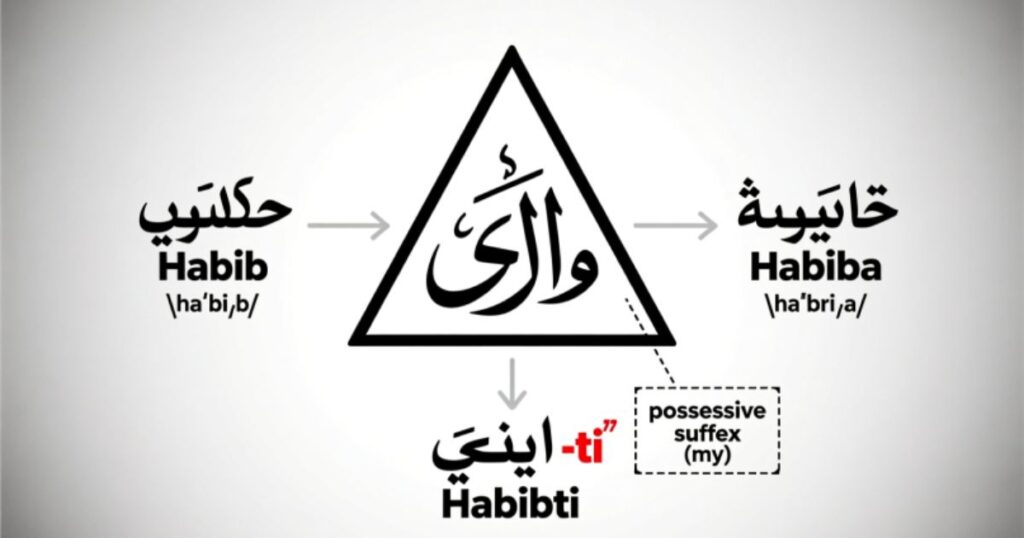
The word habibti originates from the Arabic root H-B-B (ح-ب-ب), which conveys the concept of love and affection. Understanding this root helps learners grasp how Arabic forms words and expresses emotion. From this root, we get habib (حبيب), meaning “beloved” for males, and habiba (حبيبة), the feminine form simply meaning “beloved.”
The word habibti (حبيبتي) takes this a step further by adding the possessive suffix “-ti”, which literally turns the word into “my beloved” for a female. This suffix is part of Arabic grammar rules, where possessive endings are attached to nouns to indicate ownership or closeness.
In spoken Arabic, the suffix signals intimacy and affection, making habibti a deeply personal term. Mispronouncing it or omitting the suffix can change the meaning or make the expression sound incomplete. For learners, understanding Arabic word structure and Arabic linguistics is key, especially when distinguishing between masculine and feminine forms.
By analyzing its root and suffix, you see how habibti is more than just a word; it’s a combination of grammar, culture, and emotion, perfectly illustrating the richness of Arabic language learning.
How to Pronounce Habibti Correctly
Pronouncing habibti accurately is essential for proper communication in Arabic. Phonetically, it’s pronounced ha-beeb-tee, with the stress on the second syllable. The initial “H” is a slightly guttural sound, common in Arabic phonetics, which can be tricky for non-native speakers.
Regional accents affect pronunciation slightly. In Levantine Arabic, the vowels are softer and elongated, while in Egyptian Arabic, the word may sound a bit shorter and crisper. Despite these variations, the feminine possessive suffix “-ti” remains, signaling the intimate meaning of “my beloved.”
| Syllable | Pronunciation | Stress | Notes |
| Ha | hɑ | – | Slight guttural H |
| Beeb | biːb | ✔ | Main stress |
| Ti | ti | – | Feminine possessive suffix “my” |
When learning Arabic pronunciation, paying attention to stress and suffixes helps convey the intended meaning. Listening to native speakers, whether via audio or video clips, improves mastery. Using Arabic pronunciation correctly shows both linguistic knowledge and cultural awareness, avoiding common mistakes while expressing affection naturally in spoken Arabic phrases.
Must Read:The Word Habibi Meaning in Arabic With Examples(2026)
Habibti in Arabic Script
The word habibti in Arabic is written as حبيبتي. Arabic is read right-to-left, so each letter must be understood in context. Breaking it down letter by letter helps learners visualize its structure and pronunciation.
- ح (Ha) – A slightly guttural “H” sound, unique to Arabic
- ب (Ba) – Pronounced as “b,” part of the root H-B-B
- ي (Ya) – Represents the long “ee” vowel sound
- ب (Ba) – Repeated consonant from the root
- ت (Ta) – Signals the feminine form
- ي (Ya) – The possessive suffix “-ti,” making it “my beloved”
Understanding the Arabic word structure is crucial for correct writing and pronunciation. Each letter connects differently depending on position, which is a key part of Arabic linguistics. Learning to write Habibti in Arabic script not only improves reading skills but also deepens your understanding of Arabic grammar and the cultural context of affectionate terms.
Cultural Significance & Usage
In Arab culture, habibti carries deep emotional and social significance. It’s not just a word of affection but a reflection of closeness and respect in Arabic family terms. Families often use it to address daughters, sisters, or nieces, while between spouses it conveys intimacy and love. Among close friends, it can be a playful or caring expression.
Gender etiquette is important. Men generally use habibti only when addressing women they are close to—spouses, female relatives, or close friends. Using it with the opposite gender outside appropriate contexts can be seen as improper. Similarly, the choice between formal and informal settings matters; casual conversation allows for affectionate phrases, while formal interactions rely on respectful alternatives.
Understanding Arabic terms of endearment and cultural norms ensures correct usage, prevents Arabic word misuse, and reflects both emotional intelligence and awareness of Arabic cultural significance.
Habibti in Islamic Context
The root of habibti, H-B-B (ح-ب-ب), appears in the Quran and Islamic texts to convey love, care, and divine favor. While habibti itself is a term of personal affection, understanding its Quranic Arabic usage shows the spiritual and emotional depth of the root. For example, in Quran 3:76, “Innallaha yuhibbu al-muttaqeen” translates as “Indeed, Allah loves the righteous,” demonstrating how the H-B-B root expresses divine love and moral connection.
In Islamic teachings, love is a central theme—both human and divine. Recognizing the Arabic linguistic and cultural significance of affectionate terms like habibti enriches learners’ understanding of Islamic Arabic terms and how emotional expression is interwoven with spirituality. This connection highlights that words of affection in Arabic, while everyday in use, resonate with centuries of linguistic, cultural, and religious tradition.
Common Misunderstandings or Mistakes
One of the most common mistakes non-Arabic speakers make is using habibi when addressing females. This simple gender error can lead to awkward situations or misunderstandings. Similarly, overusing habibti in formal settings may appear inappropriate, as affectionate terms are typically reserved for personal or casual contexts.
Pronunciation mistakes are also frequent. Misplacing stress, omitting the “-ti” suffix, or mispronouncing the guttural “H” can change the word’s meaning or make it sound unnatural. Cultural faux pas often occur when the word is used with the opposite gender outside close relationships, which can be considered disrespectful in Arabic cultural contexts.
Knowing when not to use habibti—with strangers, in professional environments, or in formal correspondence—ensures proper etiquette. Understanding these nuances helps learners avoid Arabic word misuse, respect Arabic gender rules, and communicate affection accurately and appropriately in spoken Arabic phrases.
Related Arabic Terms of Endearment
Arabic has many affectionate words similar to habibti. Here’s a quick comparison:
| Term | Meaning | Usage Context |
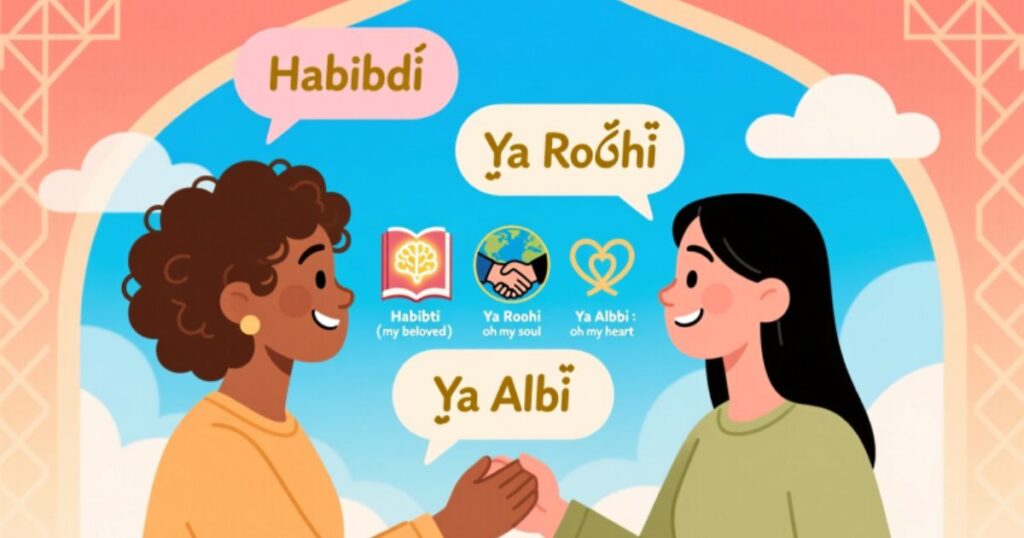
| Ya albi | My heart | Romantic or close friends |
| Ya rohi | My soul | Deep emotional connection |
| Ya omri | My life/age | Spouse or partner |
| Ya hayati | My life | Romantic partner or close friend |
| Hobbi | My love | General affection, romantic or casual |
These Arabic words for love and Arabic affectionate words enrich daily conversation. Using them correctly shows cultural awareness and helps avoid Arabic word misuse, while expressing warmth, intimacy, and respect in both casual and personal interactions.
Why You Should Learn “Habibti”
Learning terms like habibti goes beyond vocabulary it helps strengthen relationships and build deeper connections with Arabic-speaking family, friends, or partners. Using Arabic words for love appropriately shows respect and appreciation for Arabic culture.
From a language learning perspective, understanding affectionate phrases improves pronunciation, grammar, and familiarity with Arabic linguistic structures. It also enhances comprehension of spoken Arabic phrases in daily conversation. Expressing care with the right words creates a genuine emotional connection and shows cultural sensitivity, making interactions more meaningful and authentic for both learners and native speakers.
Frequently Asked Questions
What does habibti mean in Arabic?
Habibti means “my beloved” or “my darling,” and it’s the feminine form of habibi.
How do you pronounce habibti correctly?
It’s pronounced ha-beeb-tee, with stress on the second syllable and a soft “ti” ending.
When should I use habibti in conversation?
Use it with female relatives, spouses, or close friends in casual or intimate settings.
What’s the difference between habibi and habibti?
Habibi is masculine, habibti is feminine; using the wrong form can cause confusion.
How do you write habibti in Arabic script?
It’s written as حبيبتي, read right-to-left, with each letter connected depending on its position.
Can men say habibti to women in Arabic culture?
Yes, but only with close female relatives, spouses, or friends; otherwise, it may be inappropriate.
Why is habibti culturally important in Arab communities?
It expresses affection, emotional closeness, and respect, reflecting both family and romantic relationships.
Conclusion
Understanding Habibti Meaning in Arabic goes beyond a simple translation. It reflects cultural traditions, emotional expression, and linguistic richness in Arab society. From its root H-B-B to the feminine possessive suffix “-ti,” the word carries affection, intimacy, and respect in family, friendship, and romantic contexts.
Learning habibti and related Arabic terms of endearment strengthens relationships, enhances communication, and deepens appreciation for Arabic culture and language. Correct pronunciation, proper usage, and awareness of cultural norms ensure this beautiful word is expressed authentically and meaningfully in daily conversation.

Emma is a researcher and writer with 4 years of experience studying Arabic names and meanings. At MeaningOfArabic.com, she curates insightful content that connects language, culture, and identity through the timeless beauty of Arabic names.